A talk for your group? Bringing History to life through People, Places and Stories
So What Happened?
A battlefield deception involving a dead man and a briefcase. A Christmas morning when soldiers climbed out of their trenches. An armoured division equipped with machines unlike anything seen before. A Vulcan bomber flying thousands of miles across the Atlantic. Each is a very different story. But they all begin with the same question:
So, what happened?
That question sits at the heart of the talks I deliver to history societies, U3A groups, Probus clubs, community organisations and other groups across Sussex and beyond.
More than dates and events
History can easily become a sequence of dates, names and outcomes. What makes it memorable are the people involved, the places where events unfolded and the decisions that shaped what happened next. That is the approach I take with every So, What Happened? talk.
The aim is not simply to describe an event, but to put it into context and explore the human story behind it. Maps, photographs, contemporary evidence and individual accounts help build the picture, whether the subject is a First World War battlefield, a Second World War deception plan or a much broader question about Britain’s past.
Stories from the First World War
Some of the talks explore familiar events from a less familiar perspective.
The 1914 Christmas Truce, for example, has become one of the best-known stories of the First World War. But how much of the story is fact, how much has grown in the telling, and what actually happened along different parts of the Western Front?
Closer to home, the Battle of the Boar’s Head on 30 June 1916 became known as The Day Sussex Died. The story links a relatively small action on the Western Front with communities across Sussex and the families who experienced its consequences.
Another talk follows the journey of a wounded soldier from the front line to the base hospital, examining the system developed to collect, treat and evacuate casualties during the war.
Each subject offers an opportunity to look beyond the headline and understand the people and systems behind it.
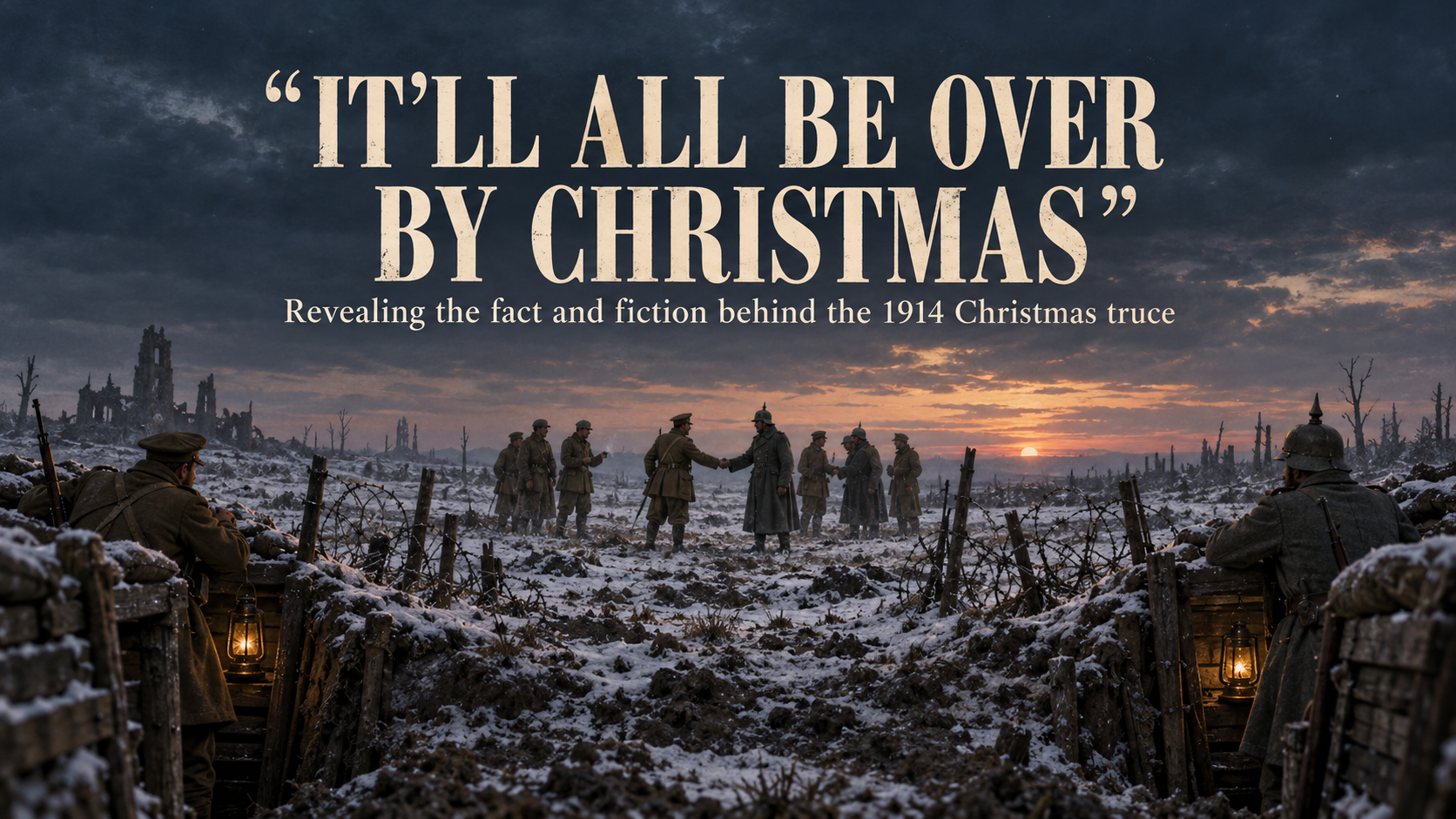
So, What really happened in December 1914?
Deception, Innovation and the Second World War
The Second World War produced some equally remarkable stories.
Operation Mincemeat used false documents carried by a dead man to help convince German intelligence that the Allies intended to invade Greece rather than Sicily.
Hobart’s Funnies tells a very different story: the development of specialist armoured vehicles designed to solve some of the problems Allied forces would face during the Normandy landings.
Both demonstrate that military history is rarely only about what happened on the battlefield. Intelligence, planning, technology and individual personalities can be every bit as important.
From Britain to the Falkland Islands
The range of talks also extends beyond the two World Wars.
Operation Black Buck explores the extraordinary long-range Vulcan missions flown during the Falklands conflict in 1982.
A separate talk follows more than four centuries of the history of the Falkland Islands, placing the events of 1982 within a much longer story.
And So, What Exactly is Britain? takes an even broader view, exploring some 2,000 years of invasion, union, political change and occasional disagreement to consider how Britain came to be what it is today.
A talk designed for an audience
Every group is different. Some audiences have a deep knowledge of military history. Others may simply be interested in a good story. The talks are designed to work for both. Each illustrated presentation lasts for around 45 minutes, with time afterwards for questions and discussion. The intention is to make the subject accessible without losing the historical detail that makes it interesting.
My own approach draws on historical research, battlefield guiding, public speaking and more than 40 years of military experience. But the most important part remains the story itself.
Our list of talks is updated as new material becomes available.
Planning your next programme?
If you organise speakers for a history society, U3A, Probus club, community group, military association or other organisation, the full range of available talks can be explored on the So, What Happened? website. Subjects currently include the First World War, Second World War, local history and wider historical topics.You can browse the individual talk descriptions and make an enquiry about a subject and date that would suit your group.
Sometimes the best way to understand history is simply to ask: So, what happened?