
From medal to military story: Five First Steps to Research a Life in Uniform
A medal without its ribbon. A photograph of an unfamiliar uniform. A service number written on the back of an envelope. A family story about Dunkirk, Monte Cassino or the Western Front. Small fragments like these can be the beginning of a much fuller account of a life in uniform. The difficulty is knowing what each clue means, how reliable it is and where it might lead.
Military research can seem daunting. Records contain unfamiliar abbreviations, changing unit structures and administrative language. Some survive in remarkable detail; others are incomplete, damaged, dispersed between archives or subject to access restrictions. A sound investigation therefore begins with a clear question and an honest assessment of the available evidence.
These five steps provide a practical starting point.
1. Gather what you already know
Begin with the person’s full name, including any alternative spellings, initials or nicknames. Add their date and place of birth, where they lived, their occupation and the names of close relatives if known.
Next, bring together the military clues already in the family. These might include service numbers, unit details, photographs, medals, letters, certificates, pay books, postcards, newspaper cuttings or entries in a family Bible. Even a partially legible stamp or handwritten note may prove useful.
Record where each piece of information came from. Was a unit named on an official document, written on a photograph many years later or remembered by a relative? You do not need to have everything before beginning an enquiry, but preserving the source of each detail protects valuable context and helps distinguish contemporary evidence from later recollection.
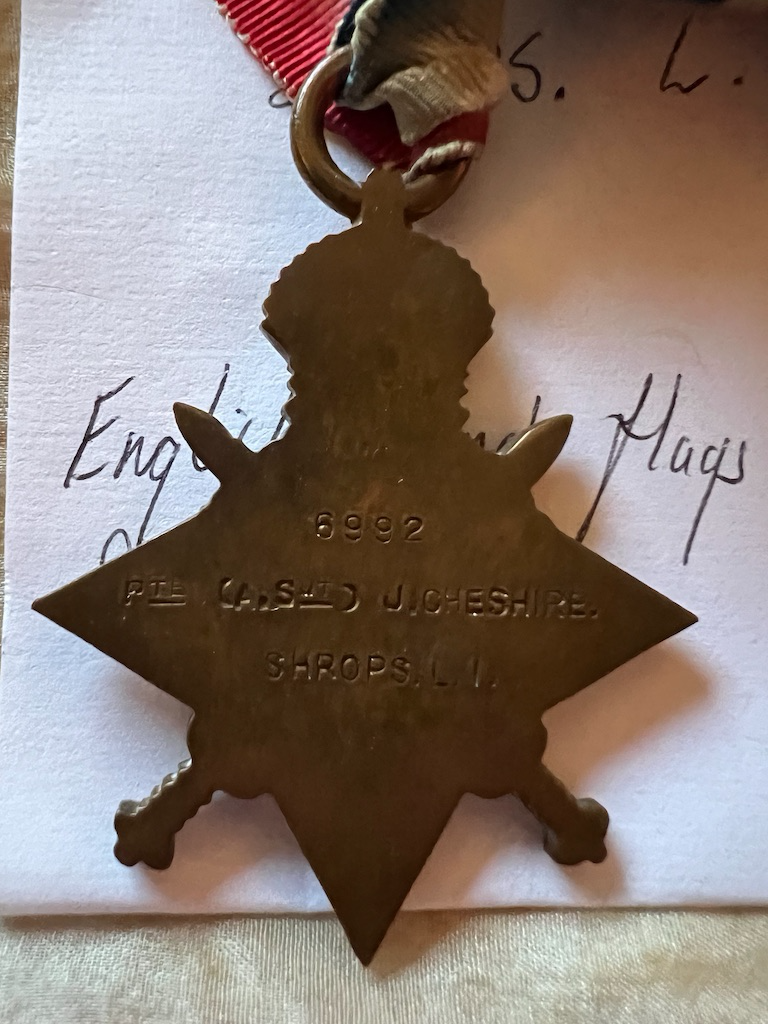
A medal can often provide useful clues. Many medals bear the names of the recipients and often provide useful additional information like the Service number, Rank and Regiment or Unit of the recipient. The medal itself can also tel us about where and when they served.
2. Read the clues carefully
Objects and photographs often reveal more than first appears. A cap badge or shoulder title may suggest a regiment or corps. Rank insignia can help date a period of service. Medal entitlement may indicate service in a particular campaign, while a postmark, photographer’s studio or place named in a letter can provide a geographical lead.
Each detail should be treated as a clue rather than a conclusion. Uniforms and insignia changed over time. Soldiers transferred between units, were attached to other formations and sometimes retained links with earlier regiments. Medals can become separated from their original recipient, and family captions—however sincerely written—can be mistaken.
The best interpretation usually comes from considering several clues together rather than relying on one badge, photograph or family story in isolation.
3. Ask one focused question
It is tempting to begin with the broad request, “Tell me everything.” In practice, research is more effective when it starts with a defined question.
Do you want to identify the unit shown in a photograph? Confirm whether someone served in a particular campaign? Understand a casualty record? Investigate an award? Trace a prisoner of war? Or reconstruct a fuller account of an entire period of service?
The question determines which records are most useful and how extensive the work needs to be. A single document may be enough for a Record Review. A question about a particular event may require Focused Service Research. Reconstructing a career across several postings, units and campaigns is more likely to call for a Full Service Story.
Defining the question at the outset also makes it easier to explain what the available evidence can—and cannot—reasonably answer.
4. Connect the individual to the unit
Personal records form only part of a military story. To understand what someone experienced, it is often necessary to establish where their unit was, what role it performed and what was happening around it.
Regimental histories, war diaries, operational records, casualty sources, maps and campaign accounts can connect an individual with the movements and experiences of their unit. A soldier may not be named in every diary entry, but the unit record can still reveal where the battalion was serving, the conditions it faced and the actions in which it took part.
This is where a list of dates and abbreviations begins to become a narrative. The purpose is not to place an individual at an event without evidence, but to set documented personal details within the right military and historical context.
5. Separate fact, inference and uncertainty
Good military research makes clear what a source directly documents, what can reasonably be inferred and what the surviving evidence cannot establish.
A record may prove that someone belonged to a particular unit on a particular date. A war diary may show that the unit was involved in an action. That does not automatically prove the individual’s precise location or personal role during the fighting.
Missing records do not always bring the investigation to an end. Other sources may allow part of the story to be reconstructed. Equally, an attractive family tradition should never be presented as fact simply because it has been repeated for many years. A careful account preserves the story while explaining whether the evidence confirms, challenges or leaves it unresolved.
Making the person visible
The aim of research is not simply to return a bundle of documents. It is to interpret ranks, units, movements and campaigns in clear language, allowing the person behind the paperwork to become visible and helping a family understand and preserve their story.
Research can also provide the foundation for a battlefield visit. Once a name, unit and sequence of events have been established, they can be connected with cemeteries, memorials, museums and surviving ground through a bespoke itinerary or personally guided experience.
If you have a name, photograph, medal, service number or family memory, begin at https://www.sowhathappened.co.uk/military-research. Every project is individually assessed, scoped and quoted before research begins, with no obligation to proceed until the scope, likely timescale and fee have been agreed.
Graeme MacPherson combines more than 40 years of military experience with historical research, public speaking and battlefield interpretation. He is an Accredited Member of the International Guild of Battlefield Guides and a volunteer speaker for the Commonwealth War Graves Commission.